Missoula College has been selected as a National Center of Academic Excellence in Cyber Defense Two-Year Education (CAE2Y). The CAE2Y program is jointly sponsored by the National Security Agency (NSA) and the US Department of Homeland Security (DHS).
The CAE2Y program has been established to proactively increase our
nation's understanding of cyber defense technology, policy, and
practices to prevent and respond to catastrophic cyber
events. This prestigious designation is awarded to recognize accredited two-year colleges with Cyber Defense Centers. CAE2Y institutions demonstrate NSA/DHS curriculum paths, faculty expertise, and community outreach in cybersecurity.
See the related news feature and story from KECI-NBC Montana
Findings of Study indicate more IT Professionals needed
eCampus News article IT #1: STEM crisis quickly becoming an IT problem stated that a massive problem is looming for society as new information technology systems come online, while not enough individuals are choosing careers in IT to support the enhanced demand. The article is based upon a recent Computer Technology Industry Association (CompTIA) report describing Generation Zs fascination with technology use does not equate to more individuals pursuing education in IT. According to the report students who said they
were interested in an IT career cited technology classes in high school
or junior high as top influences, but 38 percent of all younger-aged
students said that their school does not provide IT-focused career information.
ACET Faculty Complete Cybersecurity Training Workshop
Adjunct Assistant Professor and Cybersecurity Consultant Dianne Burke led an August Cybersecurity boot camp for ACET faculty members. Content for the boot camp was based upon the Computer Technology Industry Association Security+ curriculum. The CompTIA Security+ is a training program which meets requirements as a Department of Defense Directive 8570.1 for Information Assurance. It serves as both a Level II Information Assurance Technician (IAT) program and a Level I Information Assurance Management (IAM) program.
Following the three day boot camp, faculty members will become certified as CompTIA Security+ Professionals. Participating in the boot camp were adjunct faculty members Wally Higgins, Zach Rossmiller, and Daniel Lande along with Assistant Professor Steve Stiff and Professor Tom Gallagher.
What If We Merge Human and Machine ?
See Elon Musk's vision of what we might see in the future for the human-computer interface (HCI) and how technology and humans can merge.
Cummings Selected as Outstanding IT Student
Jack Cummings was selected as the 2017 Outstanding Student Award for the Department of Applied Computing & Engineering Technology at Missoula College. Outstanding Student is an annual award sponsored by the Mortar Board. It celebrates academic excellence and outstanding service of a graduating student. Jack will be receiving the AAS degree in IT - Programming & App Development. In addition to being an excellent student, Jack has demonstrated outstanding service as a trustworthy tutor for students on the Missoula College campus. Congratulations to Jack and the entire graduating class of 2017! Picture below are: Professor Tom Gallagher, Jack Cummings, Lucas Ogala, and Professor Steve Shen (Left to Right). Lucas is the First Call Computer Solutions Intern and scholarship recipient.
Sustainability Award Goes to Missoula College Professor
The Sustainable Campus Committee recognized Missoula College Associate Professor Brad Layton as winner of the 2017 UM Sustainability Faculty Award. Dr. Layton has been with the College since 2010. He has been an constant advocate for sustainable energy on the UM campus and across the State of Montana. Countless students have benefited under Brad's tutelage in honing their passion and expertise for developing practical solutions in sustainable energy technologies.
Brad will be leading a group of students from Blackfeet Community College in an Energy Technology Practicum taking place in Browning during the month of June. These students will be completing a series of sustainable energy education activities.
Students Participate in National Cybersecurity Competition
Missoula College students participated in a month-long, nationwide series of cybersecurity activities. “These students are graduating with an A.A.S. in Information Technology – Network Administration & Security, and this is a chance for them to test their skills and knowledge against their peers,” said Adjunct Professor Dianne Burke, who leads the ITS 222 and ITS 271 courses that participated.
The first several days of the competition gives students the opportunity to refresh their skills or learn new information through online labs and review activities. The materials include topics such as Password Cracking, Log Analysis, Cryptography, Network Traffic Analysis, and Web and Wireless Vulnerabilities. “Students tend to like his part of the competition since there’s no pressure, and they can select exercises that sound interesting,” stated Burke. “The Preseason and Regular Season competitions that follow kick up the intensity.”
The Preseason phase assess student knowledge in four domains: general cybersecurity knowledge, cryptography, network traffic analysis, and log file analysis. Students are ranked based on their accuracy – how quickly they found the correct answer – and completion – how many questions were answered correctly. “Overall, everyone scored in the top 40% or higher. Almost 1900 students competed, so Missoula College did really well,” explained Burke.
When asked which areas were problematic for students, Burke laughed and said “They did really well in general cybersecurity knowledge and cryptography. Next year I’m going to spend more time on network traffic and log analysis before we start competing.”
The first several days of the competition gives students the opportunity to refresh their skills or learn new information through online labs and review activities. The materials include topics such as Password Cracking, Log Analysis, Cryptography, Network Traffic Analysis, and Web and Wireless Vulnerabilities. “Students tend to like his part of the competition since there’s no pressure, and they can select exercises that sound interesting,” stated Burke. “The Preseason and Regular Season competitions that follow kick up the intensity.”
The Preseason phase assess student knowledge in four domains: general cybersecurity knowledge, cryptography, network traffic analysis, and log file analysis. Students are ranked based on their accuracy – how quickly they found the correct answer – and completion – how many questions were answered correctly. “Overall, everyone scored in the top 40% or higher. Almost 1900 students competed, so Missoula College did really well,” explained Burke.
When asked which areas were problematic for students, Burke laughed and said “They did really well in general cybersecurity knowledge and cryptography. Next year I’m going to spend more time on network traffic and log analysis before we start competing.”
Congrats to Cisco Networking Students
Students completing the AAS degree in IT - Network Administration and Security pose for a picture following completion of a skills-based final assessment. These students will be graduating from Missoula College to assume positions in the workforce as system administrators, network engineers, computer support professionals, and cybersecurity experts.
Missoula College offers a four-course sequence in IP networking based upon the Cisco CCNA curriculum. Lecturer Wally Higgins leads the Cisco Regional Academy for the Department of Applied Computing & Engineering Technology at the University of Montana.
Cybersecurity Consultant Presents to IT Students
Karen Sprenger from Lake Missoula Group (LMG) Security presented to Missoula College IT students on September 30th. Karen led discussion on careers in cybersecurity, what employers are looking for in applicants, and "Tales from the Trenches". Included in the "Tales from the Trenches" was a demonstration on the impact of Ransomware on enterprise data and how LMG assists organizations to prevent and recover from a data breech.
Missoula College hosts Information Technology Advisory Meeting
The Advisory Committee for Missoula College's Information Technology Degree and Certificate programs met on Friday April 21, 2017. Advisory committees serve an important role in connecting education with business and industry. Advisory committee input is essential in guiding Career Technical Education (CTE) programs of study and enhancing their relevance. The committee reviewed the academic program's curriculum, student enrollment, and graduate data. Internships with local businesses were highlighted and new initiative such as the work-based learning models were discussed. The meeting was held at the new Missoula College River Campus. Following the meeting members of the committee were give a tour of the new Missoula College campus. Beginning Autumn Term 2017, all classes for IT students will be on the new campus.
Gallagher Presents EHR Synthetic Records Research at IEEE Conference
Information Technology Program Director and Professor Tom Gallagher presented the paper Using the CareMap with Health Incidents Statistics for Generating the Realistic Synthetic Electronic Healthcare Record at the 2016 IEEE International Conference on Healthcare Informatics in Chicago. The paper further develops the privacy enhancing technology of the Realistic Synthetic Electronic Health Record (RS-EHR) for protecting personal health information (PHI). The RS-EHR was originally developed by Gallagher and Dube (Massey University, NZ) in 2013 in an effort to preserve patient privacy and security. It seeks to limit secondary use of patient PHI through the generation of synthetic EHR data.
Burke Delivers Privacy Presentation at Security Conference
Adjunct Professor and Cybersecurity Consultant Dianne Burke delivered the presentation Digital Fingerprints and Footprints – Privacy in the Digital Age at the 2017 Big Sky Information Security Conference held at the University of Montana on April 19. Her presentation discussed how digital information is generated and collected in our daily lives both intentionally and unintentionally. Professor Burke described how data collection takes place through common technologies such as cell phones, mobile applications, telematics and GPS tracking are covered with an emphasis on how personal privacy is impacted. Further details are found: http://www.umt.edu/security-conference/
Computer Science Teacher Licensure
A partnership between faculty members from Computer Science, Education, and Applied Computing & Engineering Technology has developed the first K12 teacher licensure education program in the State of Montana for computer science. Limited opportunities in coding and programming are available to students at most high schools in Montana. A major obstacle has been the lack of qualified teachers in the curricular area of computer science. This important program of study has been developed to assist K12 schools by providing teacher education in the computer science domain. The curriculum for these teachers in training will include completion of CSCI 105 Computer Fluency and ITS 150 Cisco Networking I at Missoula College. Intentions are to enroll students in this new program by Autumn 2017.
A Special Moment in our Nation's Capital
The Energy Technology Program, in partnership with the Climate Change Studies Minor, the Blackfeet Community College, Environmental Studies, and local industry partner, Satic, represent the Montana University System at the 2016 National Science Foundation PI Meeting. This meeting represents the third and final meeting for this three-year $728k Project that has trained and educated nearly one hundred students in Renewable Energy Technology.
Back row: Bradley Layton, Missoula College & PI; John Pickens Blackfeet Community College; Greg Gonstad, University of Montana Environmental Studies student representative.
Associate Professor Layton Discusses Renewable Energy Technology
Associate Professor Layton discusses the future of renewable energy technology in Montana with Bob Seidenschwarz, Jon King, and Peter Christian on KVGO's Talkback August, 2016.
Mobile solar electric installation facility arrives at the University of Montana
We are thrilled that Energy Technology industry partner OnSite Energy has completed and delivered a brand-new custom-made mobile solar electric training facility.
This training lab features three state-of-the wiring configurations to ensure that trainees have the skills to tackle new installations and maintain conventional systems.
This laboratory was made possible in part of a three-year $730k National Science Foundation Advanced Technological Education grant for which Associate Professor Layton is serving as Principle Investigator. NorthWestern Energy also provided financial support for the trailer's construction.
For more information visit: http://www.missoulacurrent.com/business/2016/04/new-solar-lab-boost-missoula-college-energy-technology-program/
Bradley Layton of Missoula College, and Conor Darby of OnSite Energy show off the training facility at the recently held Earth Day celebration held by MUD, the Missoula Urban Demonstration project.
This training lab features three state-of-the wiring configurations to ensure that trainees have the skills to tackle new installations and maintain conventional systems.
Bradley Layton, Conor Darby and Timothy Chester deploy the trailer behind Main Hall during the Earth Week celebrations. It was great seeing the Provost and the President both taking a keen interest in the University's hands-on approach to its commitment to becoming carbon neutral by 2020!
This laboratory was made possible in part of a three-year $730k National Science Foundation Advanced Technological Education grant for which Associate Professor Layton is serving as Principle Investigator. NorthWestern Energy also provided financial support for the trailer's construction.
For more information visit: http://www.missoulacurrent.com/business/2016/04/new-solar-lab-boost-missoula-college-energy-technology-program/
Energy Tech Student Receives NASA Scholarship
Shauna Muns received a $5,500 scholarship from NASA to build a sensor
and control unit for a rocket stove. Muns said she heard about the
scholarship through an email sent by the program director. “Who doesn’t want a scholarship from NASA?” Muns said. “The more research I did, the more interested I was.” A rocket stove is an efficient and hot-burning portable stove
that uses small wood fuel pellets. Muns is testing the efficiency of
the stove using different fuels, while also measuring emissions. Energy
technology teaching assistant Tim Chester is working closely with Muns
on the project. He said since there has not been a lot of research on
the stoves before, they are excited to get factual information out
there.Muns will present her project at the Montana Space Grant
Consortium Student Research Symposium in April. Muns and Chester are
working on building different versions of the stove to test efficiency
and gather data for pictures and videos. But the project doesn’t end
there.
See the complete article from the Montana Kaimen
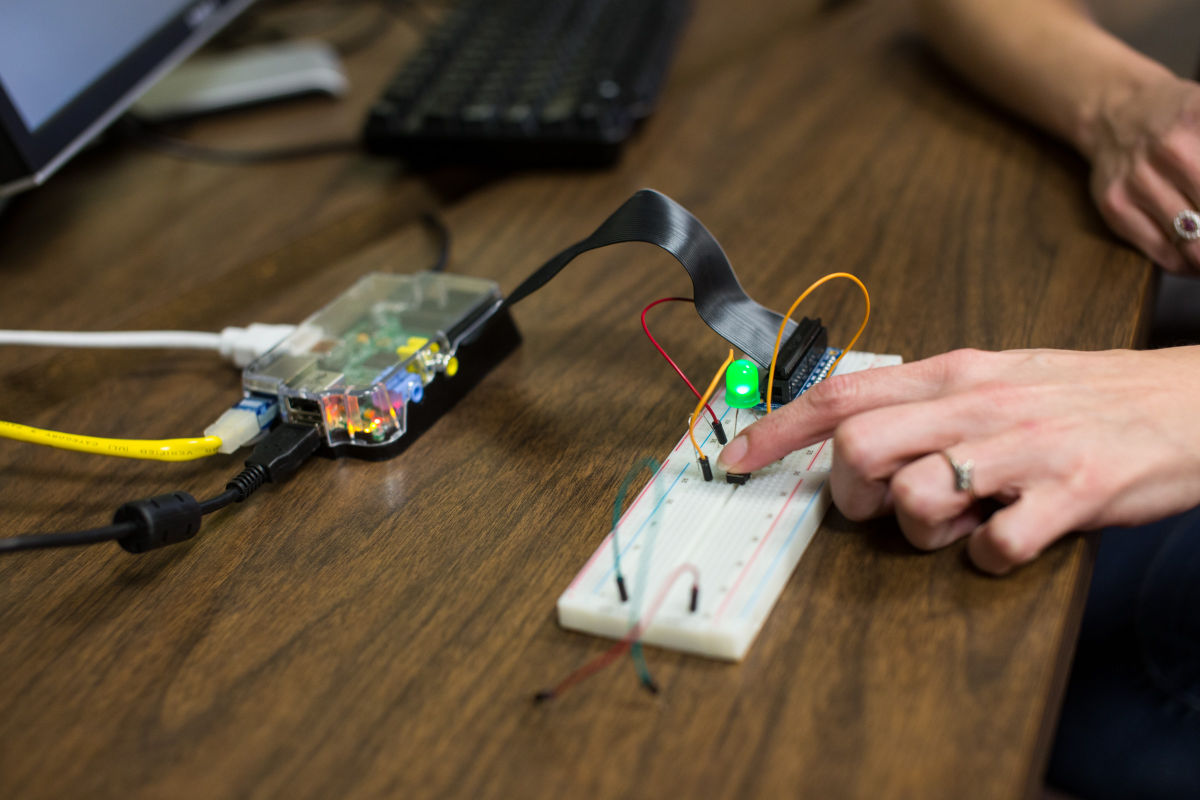
Demonstration of sensor input using the Raspberry Pi
2016 HOSA Symposia
UM faculty members Kari McLean, Michelle Boller, Dave Montain, and
Tom Gallagher provided presentations to high school students at the
Montana Health Occupations Student Association State Symposia on March 22. McLean and Montain discussed the various areas of IT supporting clinicians in healthcare facilities and described opportunities for careers associated with these positions. Kari is nursing informatician, implementation specialist with Cerner, and UM faculty member. Dave is a pharmacist informatician at Billings Clinic, and UM faculty member.
Boller provided an interactive Electronic Health Record activity to students, while Gallagher demonstrated the use of sensors and mobiles devices as technological tools for improving healthcare. Michelle Boller is an assistant professor from Business Technology and directs the Medical IT program of study. Tom Gallagher is a professor and directs the Information Technology program of study.
UM has one-year and two-year programs of study in Computer Support, Network Administration & Security, Medical Coding, Medical Administrative Assisting, and Medical Reception at Missoula College. A professional certificate in Healthcare IT is available for clinicians and IT support professionals. UM and Montana Tech partner in offering the baccalaureate degree in Health Care Informatics through a 2 + 2 program of study.
Informatics Pharmacist Dave Montain discusses the Health IT infrastructure at Billing Clinic
ACET Professor Tom Gallagher discusses smartphones, mobile apps, and sensors for patient nutrition
Energy Technology Student Shauna Muns Recieves NASA Scholarship
Energy Technology Student Shauna Muns (left) was recently awarded a $5,500 scholarship from NASA to bring a scientific approach to rocket stove design and operation. With the assistance of NASA and help from Jen Fowler (right), Shauna
will work with Associate Professor Bradley Layton and Tim Chester Energy
Technology `13 to build a sensor and control system for a next
generation rocket stove.
As a civilization, humans consume new biomass at a rate approximately one-quarter at which it is replaced and ancient biomass at a rate ten million times faster than it was created (Schramski et al 2015)
The so-called "rocket stove" is an innovated approach to burn woody biomass efficiently and cleanly, but with its high temperatures, may create unwanted greenhouse gasses such as NOx. This research is already underway and will be tested during the 2016 Energy Technology Practicum in Missoula and Browning.
As a civilization, humans consume new biomass at a rate approximately one-quarter at which it is replaced and ancient biomass at a rate ten million times faster than it was created (Schramski et al 2015)
The so-called "rocket stove" is an innovated approach to burn woody biomass efficiently and cleanly, but with its high temperatures, may create unwanted greenhouse gasses such as NOx. This research is already underway and will be tested during the 2016 Energy Technology Practicum in Missoula and Browning.
President Obama Calls on Country to Deliver CS Education to All Students
President Obama said he wants to see a stronger commitment to computer
science in American schools, and he's laid out a new initiative to make
that a reality. The "Computer Science for All"
program will seek Congressional funding to add CS at all levels of
K-12, the use of resources at federal agencies such as the National Science Foundation (NSF) to expand CS training for teachers and public and private support for promoting CS education.
Further details on President Obama's comments are available at the Campus Technology Website.
Subscribe to:
Comments (Atom)